%201.svg)


The global AI market is on a sharp upward trajectory. According to Statista, it’s projected to reach $243.7 billion in 2025 and surge to nearly $826.7 billion by 2030.
Within this booming sector, the AI agent segment is growing at an even faster clip. Valued at $5.1 billion in 2024, it’s forecast to grow at a staggering CAGR of 44.8%, reaching $47.1 billion by 2030. These numbers prove one thing: AI agents are not just an emerging tool—they’re fast becoming the backbone of modern business.
For small and medium-sized businesses (SMBs), this presents both opportunity and challenge. AI agents promise cost savings, productivity gains, and better customer experiences. Yet, while enterprises can absorb complex pricing structures and fluctuating costs, pricing confusion is still the #1 adoption barrier for SMBs.
SMBs ask:
- How do we forecast costs when usage fluctuates seasonally?
- Why do some vendors bundle AI behind expensive platform subscriptions?
- How can we adopt AI without surprise bills or hidden fees?
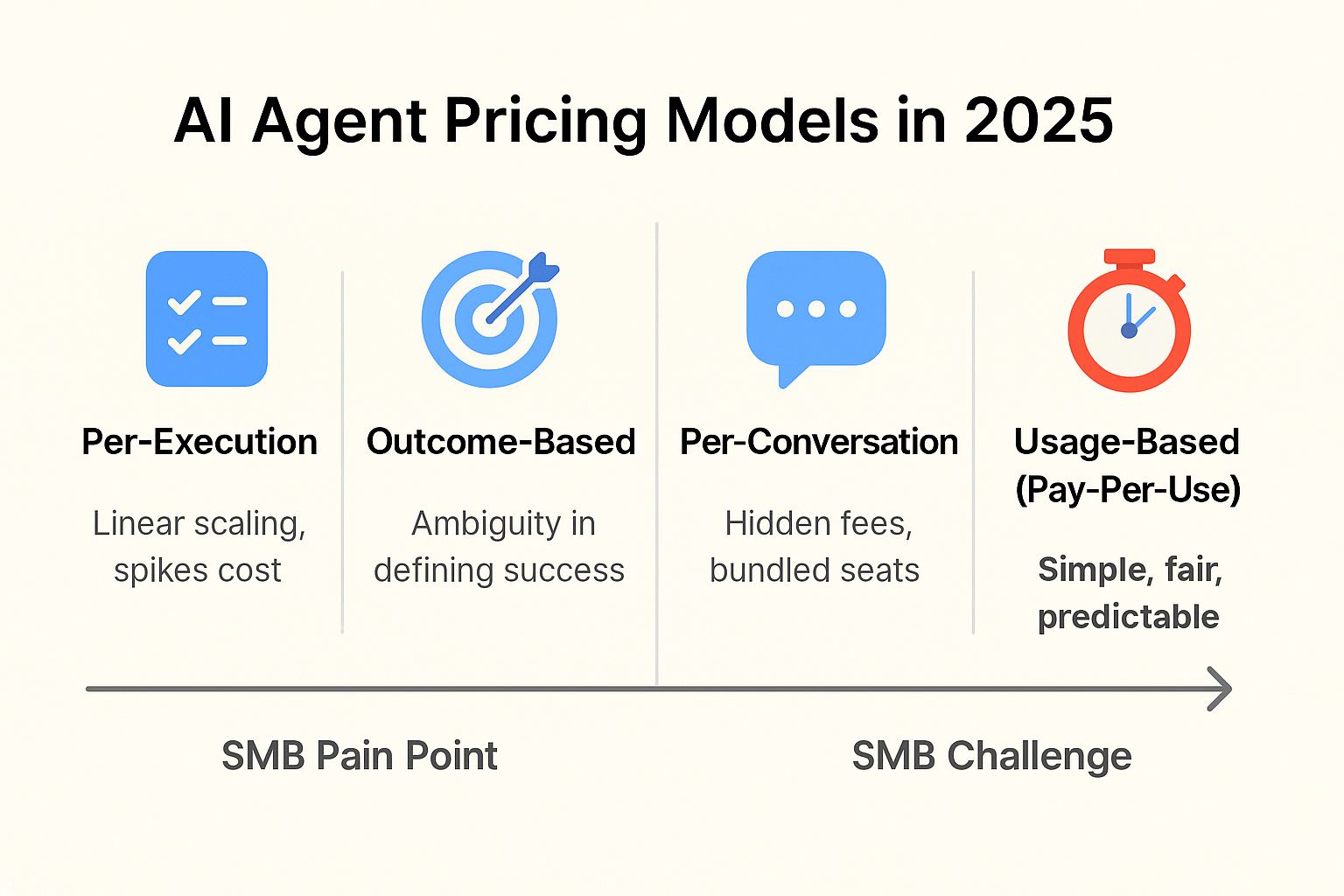
Various AI agent pricing models have emerged with different implications for cost predictability, scalability, and ease of use:
- Per-execution pricing
- Outcome-based pricing
- Per-conversation pricing
- Usage-based (pay-per-use) pricing
- Hybrid models combining elements of the above
This guide dives deep into these models, unpacks hidden costs you might encounter, examines how enterprise and SMB needs diverge, and explains precisely which model delivers the best path forward for budget-conscious SMBs in 2025.
The Four Core AI Agent Pricing Models - Pros, Cons, and Real-World Impacts
1. Per-Execution (Run-Based) Pricing
Definition: A fixed fee for each completed task-regardless of complexity (simple query or multi-step resolution).
Example: Agentman.ai charges a flat rate per task completion, promising predictable workload-based billing.
Key Benefits:
- Simplicity: You pay only per execution. No tokens, no seats, no install fees.
- Outcome-neutral: Complexity doesn’t change the price you're charged.
Key Drawbacks:
- Scale issues: As interaction volume increases, costs can climb quickly in a linear fashion.
- Not flexible for surges: Unexpected peaks can cause serious budget overruns unless you plan for them in advance.
SMB Takeaway: Good for stable, low-volume processes-but expensive and inflexible for seasonal or rapidly scaling operations.
2. Outcome-Based Pricing
Definition: Billing occurs only upon achieving predefined outcomes (e.g., a sale closed, a qualified lead generated, or a ticket successfully resolved).
Example: Sierra.ai positions its pricing model around measurable business results.
Pros:
- Aligned incentives: You pay only for success-vendor and customer goals are aligned.
- Reduced risk for SMBs: Especially in sales scenarios, where paying only for outcomes seems appealing.
Cons:
- Subjectivity: Disputes often arise-what defines “resolved”? Does a “qualified lead” mean a demo scheduled or a closed deal?
- Implementation complexity: Requires clearly defined, measurable outcomes and tracking mechanisms.
Ideal For: SMBs with high clarity on outcome definitions and strong tracking systems. Less practical in support or operational contexts with nuanced success metrics.
3. Per-Conversation Pricing
Definition: Pricing is computed per conversation handled by the AI agent (e.g., $2 per chat session).
Example: Salesforce’s Agentforce charges approximately $2 per conversation only after you’ve bought expensive Salesforce CRM platform seats.
Advantages:
- Easy to understand: “One conversation equals one price”-clear and simple at low volumes.
- Appealing to low-volume, high-value agents.
Disadvantages:
- Costs escalate quickly: With just moderate volume, pricing becomes prohibitive.
- Hidden platform costs: Must also account for seat licenses, CRM subscriptions, premium API access, or data modules.
Best For: SMBs with extremely low interaction volumes and pre-existing investments in enterprise platforms.
4. Usage-Based (Pay-Per-Use) Pricing
Definition: Pay based on consumption-typically measured in tokens, API calls, compute time, or agent-use minutes.
Used by: LLM API providers (e.g., OpenAI), Microsoft Copilot Studio (via message packs), and others.
Benefits:
- Fairness and flexibility: You pay exactly for what you consume-no wasted capacity.
- Scalability: Ideal for growing businesses or those with unpredictable workloads.
Drawbacks:
- Complexity: Requires active monitoring, token counting, prompt optimization, or message tracking, which can be technical.
- Budget variability: Without proper caps, monthly costs can skyrocket unexpectedly.
SMB Outlook: Strong potential if designed with clarity, caps, and real-time usage visibility-but many implementations are too technical or unbounded for SMBs.
5. Hybrid Pricing Models
Definition: Combines elements from the above models-e.g., per-conversation bundled with outcome-based credits, or subscription plus usage-based layers.
Why Vendors Use It: To cater to diverse customer needs and force upsells.
Real Risks for SMBs:
- Confusion: Multiple pricing schemes create decision paralysis.
- Hidden escalation paths: SMBs may inadvertently reach more expensive tiers or incur overages.
SMB Priority: Favors simplicity over flexibility-too many blended models lead to ambiguity and adoption delays.
What SMBs Must Watch Out For – Hidden Costs and Budget Pitfalls
Even beyond headline models, vendors often hide extra charges:
- Professional Services Fees: Enterprise-focused platforms may require $ 50,000–$ 200,000 in setup, integration, and time (3–6 months or more).
- Platform & Seat Dependencies: Bundling AI agents only as add-ons to CRM or service platforms forces you to buy expensive seat licenses.
- API or Data Access Layers: Some vendors require premium data access tiers, credit bundles, or API gateways just to use “basic” features.
- Ongoing Maintenance Costs: Workflow tuning, staff training, and agent tweaks add recurring overhead.
- Escalation Penalties: Auto upgrades to higher tiers or consumption blocks without clear notice can drastically inflate monthly bills.
SMBs Need: Full transparency on total cost of ownership-not just “agent price,” and control mechanisms to stop runaway spending.
Enterprise vs SMB Pricing Strategies – A Tale of Two Markets
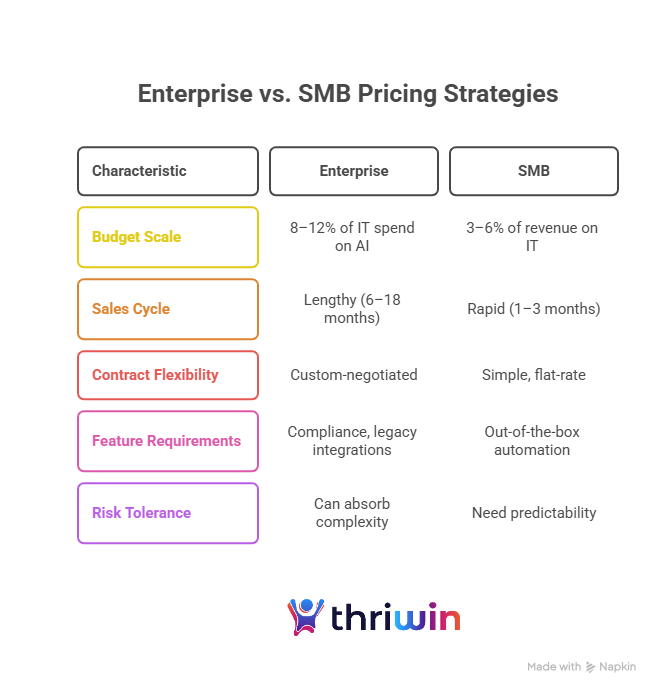
SMB Insight: Complex pricing models or bloated enterprise contracts deter adoption. SMBs thrive with models that are simple, transparent, and easy to implement.
Thriwin’s Pay-Per-Use Pricing Model - The SMB Ideal
Thriwin’s pricing is built around SMB realities-not enterprise frameworks. Let’s break down why it works.
1. A Clear, Fair Usage Metric
- “Agent-use minutes” or similar simple units, not tokens, seats, or bundles.
- Pay only for what you use. If you don't consume, you don’t pay.
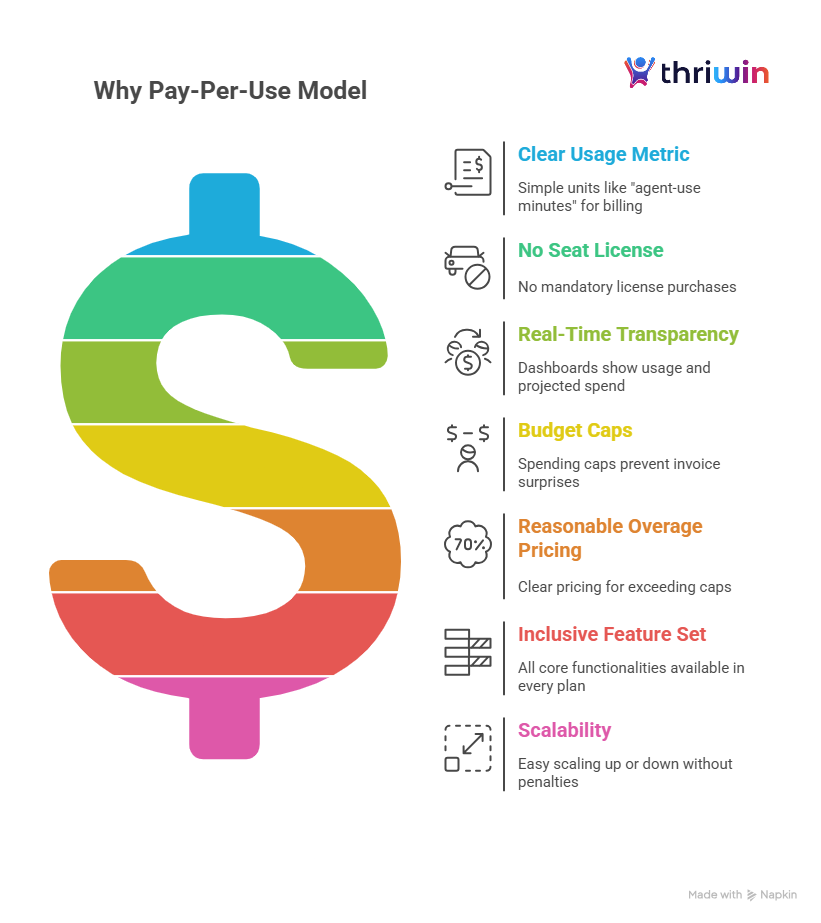
2. No Seat License or Platform Tax
- Unlike systems requiring CRM or customer engagement platform seats, Thriwin’s model is standalone.
- Your cost isn't inflated by mandatory license purchases.
3. Real-Time Usage Transparency
- Dashboards display usage and projected spend in real-time.
- No guessing-teams see exactly where they stand before billing surprises.
4. Budget Caps and Preemptive Throttling
- You set a spending cap. Once reached, non-essential agent workflows throttle automatically.
- Prevents invoices from spiraling out of control during spikes or rush periods.
5. Reasonable Overage Pricing
- Decided to exceed your cap? Overage is clearly priced per unit-not at exponential tier jump rates.
- Flexible, not punitive.
6. Inclusive Feature Set
- All core functionalities-reasoning, retrieval, automations- are available in every plan.
- No gated “enterprise features” behind lock-ins or expensive tiers.
7. Scale Up/Down with Ease
- Seasonal peaks? Scale up. Quiet periods? Scale down or pause-no penalties, pro-rated billing, or roster shifts.
Bottom Line: Thriwin’s pay-per-use model provides SMBs with control, trust, and cost clarity-exactly what they need to adopt AI confidently.
SMB Insight: The challenge is not just pricing per se, but the complexity behind how vendors structure it. Thriwin’s model distills this into a single, predictable pay-per-use unit with built-in controls.
How to Choose Your AI Agent Pricing Model- 6-Step SMB Buyer Framework
- Understand Your Volume & Seasonality
Map out quiet, normal, and peak months. Choose a model that absorbs surges without breaking your monthly budget. - Compare Total Cost of Ownership (TCO)
Don’t just check headline rates-factor in hidden seat licensing, data access, support, and implementation. - Assess Forecasting Needs
Can you predict usage? If not, favor transparent usage models with caps over per-execution or tiered bundles. - Prioritize Transparency & Controls
Real-time dashboards, spending alerts, and hard caps give you peace of mind.
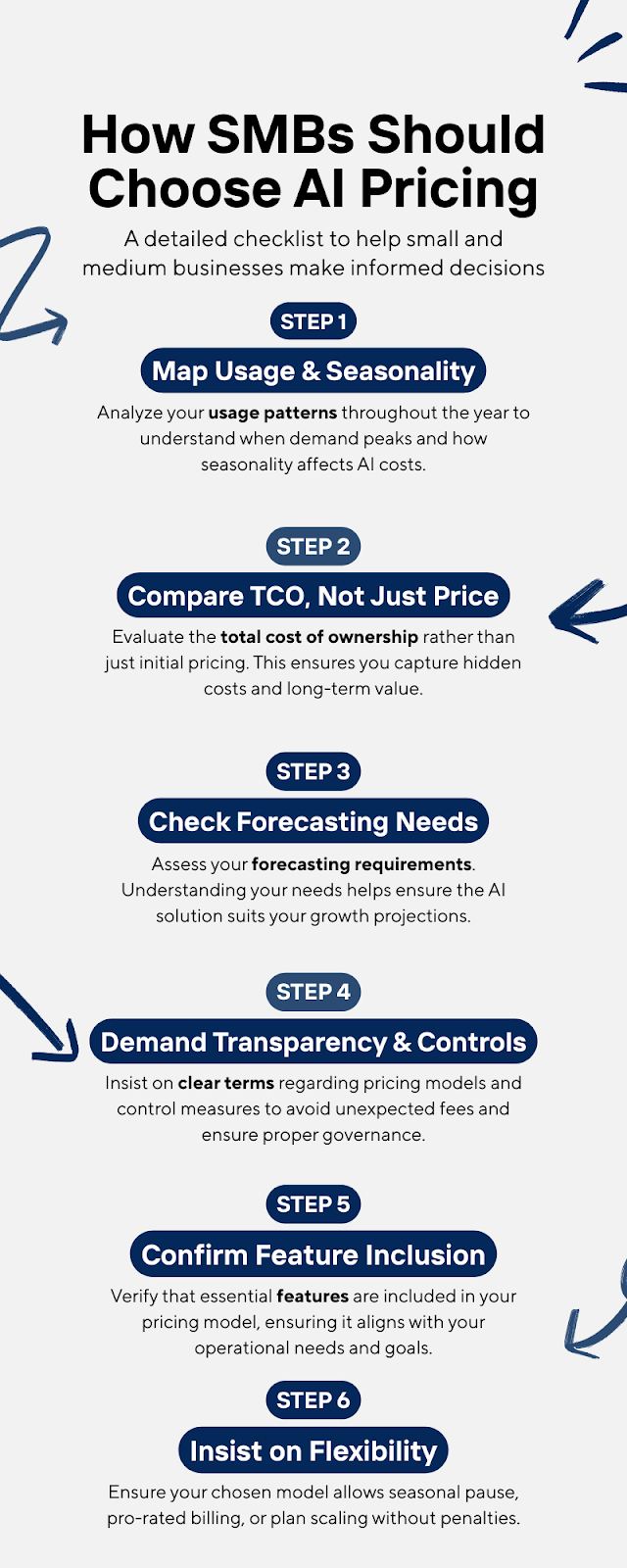
- Check Feature Availability Upfront
Avoid vendors that lock essential features behind enterprise-only tiers. - Demand Flexibility & Non-Lock-In Terms
Ensure your chosen model allows seasonal pause, pro-rated billing, or plan scaling without penalties.
Final Thoughts: Finding Clarity in a Complex Market
The AI industry is expanding at breakneck speed, with AI agents leading the charge. Pricing models have multiplied—from per-execution to outcome-based to per-conversation, and countless hybrid variations. While each has merit, they often create confusion, unpredictability, and hidden costs that weigh heavily on SMBs.
We’ve seen how:
- Per-execution models create linear cost scaling.
- Outcome-based models introduce ambiguity.
- Per-conversation pricing escalates costs at scale and hides fees in platform bundles.
- Usage-based models, when poorly designed, force SMBs to monitor tokens and APIs like developers rather than business leaders.
Enterprises may navigate this with big budgets and in-house IT teams. But SMBs require something different: simplicity, transparency, and flexibility.
That’s why Thriwin’s pay-per-use pricing model stands out. It combines the fairness of usage-based billing with the predictability SMBs need—delivering:
- One clear usage metric (no tokens or seats).
- Real-time dashboards and caps (no surprises).
- Inclusive features and flexibility (no forced enterprise upgrades).
For budget-conscious SMBs, this isn’t just another pricing option—it’s the most practical pathway to adopt AI agents confidently, scale sustainably, and capture the immense value of a market set to grow nearly 10x by 2030.
Call to Action
Ready to adopt AI agents with cost certainty and flexibility?
Explore Thriwin’s pay-per-use pricing model and see how SMBs like yours can deploy, scale, and succeed without financial guesswork.
For a preview, request a free trial with usage tracking and customizable budget thresholds to see how thousands of agent-minutes translate into savings, productivity, and growth.

.webp)
.webp)