%201.svg)


How AI-Powered CRM Software is Revolutionizing Sales & Customer Engagement
Artificial intelligence is redefining how businesses attract, engage, and retain customers, particularly in competitive sectors like U.S. immigration law firms and home improvement services, where personalization and speed are critical. Modern AI CRM software surpasses traditional CRMs by predicting intent, automating workflows, and delivering hyper-personalized experiences at scale, helping teams close deals faster and nurture long-term loyalty.
What Is an Intelligent AI CRM?
An AI CRM is a customer-relationship-management system enhanced with artificial intelligence to automate tasks, score leads, personalise journeys, and deliver predictive insights. Unlike traditional CRMs that act as static databases, AI CRMs continuously learn from behavioral patterns, historical interactions, and real-time engagement signals.
Core Capabilities Modern AI CRMs Provide
Modern AI CRMs integrate features like predictive lead scoring, automated data enrichment, AI-generated content suggestions, sentiment monitoring, forecasting, and advanced personalization engines. Some platforms now offer autonomous workflow execution, real-time intent detection, and proactive recommendations that adapt dynamically to customer journeys.
How AI CRMs Are Different from Traditional CRMs
Traditional CRMs primarily act as manual data repositories, offering limited insight unless teams conduct deep analysis. AI-powered CRMs, however, function as intelligent decision engines, automating updates, detecting patterns, and recommending actions using statistical and machine learning models. This transforms the entire customer lifecycle—from lead generation to retention—into an insight-rich, proactive process.
How AI CRM Systems Function Behind the Scenes
AI CRMs combine machine learning, natural language processing (NLP), and automation layers to turn raw data into actionable insights.
- Data Integration, Cleansing & Automated Record Intelligence
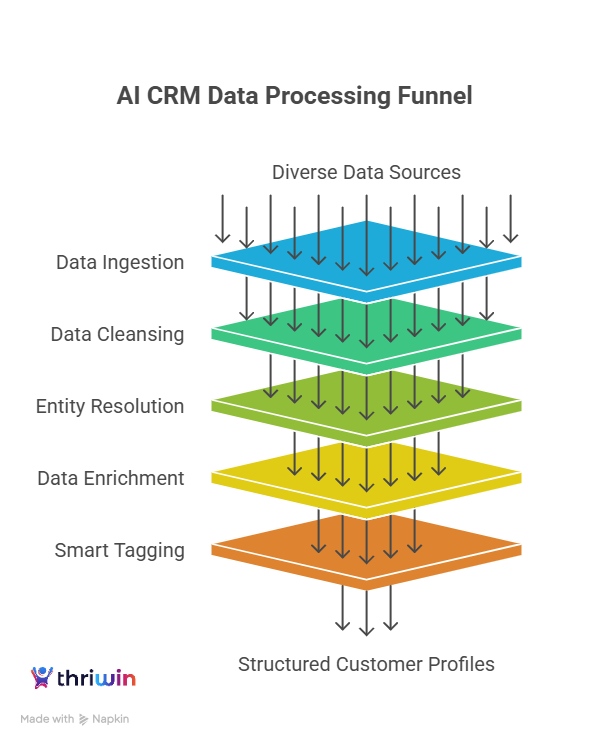
AI-powered CRMs integrate marketing, sales, support, product analytics, and offline channels into a single system. Data is pulled from emails, chat systems, call transcripts, forms, and more. Once ingested, AI:
- Detects and merges duplicates for unified profiles.
- Resolves entities to ensure multiple sources refer to the same lead.
- Enriches records automatically with historical behavior and third-party data.
- Tags and categorizes interactions (e.g., interest, sentiment, urgency).
This process reduces errors, eliminates redundant data entry, and provides a reliable foundation for predictive insights.
Predictive Engines for Scoring, Forecasting & Recommendations
After cleansing, predictive engines activate, leveraging historical outcomes—wins, losses, churn, upsells—to identify the signals that matter most.
Step-by-step workflow:
- Signal ingestion: Track emails opened, pages visited, lifecycle stage, and past interactions.
- Feature extraction: Convert raw behavior into patterns (frequency, recency, intent).
- Model scoring: Machine learning evaluates leads and customers against successful conversion patterns.
- Prediction output: Assign probabilities for conversion, churn, or deal health.
- Action layer activation: Trigger automations such as alerts, workflow activation, segment updates, messaging, or forecast adjustments.
As usage data accumulates, the AI models refine themselves, improving recommendations over time.
Why 2026 Is a Turning Point for AI-First CRMs
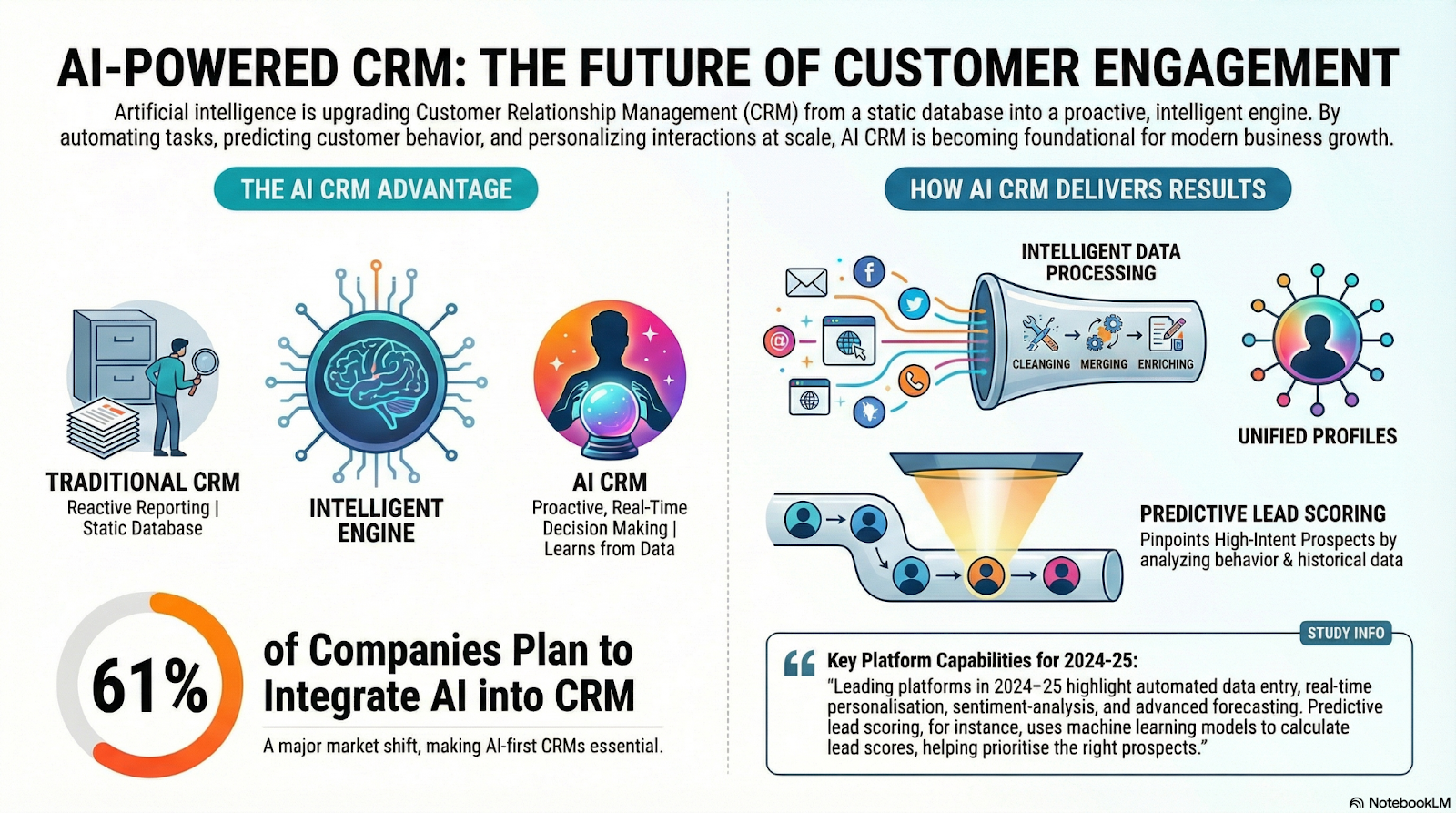
According to Dialectica, 61% of companies plan to integrate AI into their CRM over the next three years, signaling that AI-first CRMs are no longer optional—they are foundational.
AI-first CRMs enable organizations to move from reactive reporting to proactive decision-making, surfacing risks and opportunities in real time. Features like automated outreach, real-time engagement scoring, and multi-channel orchestration are now expected standards.
The Evolving Role of AI in CRM Platforms Today
AI’s role in CRM has shifted from optional augmentation to the core engine powering automation, insights, and personalisation.
New AI Capabilities Defining the Current CRM Landscape
AI CRMs now provide intelligent prioritisation, automated outreach generation, real-time engagement scoring, and unified data orchestration, enabling faster decisions with less manual effort.
Key Features such as:
- Draft personalized emails automatically.
- Summarize meetings and log tasks.
- Detect buyer-intent signals in real-time.
- Auto-route leads and support tickets based on sentiment & priority.
Benefits of AI-Driven CRM Across Sales, Marketing & Support
AI significantly boosts productivity, conversion efficiency, and customer engagement across revenue-generating functions. By automating manual processes, improving decision accuracy, and enabling real-time personalisation, AI-driven CRM systems help organisations operate faster and with greater precision. Below are the core benefits businesses experience when adopting intelligent CRM capabilities.
Improved Conversion Rates
By prioritizing high-probability leads, AI reduces guesswork and accelerates the journey from interest to close, enabling teams to focus on U.S. immigration leads or home maintenance prospects most likely to convert.
Personalized Experiences at Scale
One-to-one personalization occurs automatically across channels, boosting engagement without additional manual effort.
Enhanced Productivity Through Automation
Reps save hours by automating repetitive tasks—data entry, follow-ups, meeting notes—allowing focus on meaningful conversations.
Better Customer Retention
AI identifies early churn risks and triggers interventions, providing the opportunity to re-engage clients before problems escalate.
Predictive Lead Scoring: The Backbone of Modern AI CRM
Predictive lead scoring is central to AI CRM, evaluating thousands of behavioral and contextual signals to identify high-intent prospects.
How Predictive Scoring Models Identify High-Intent Leads
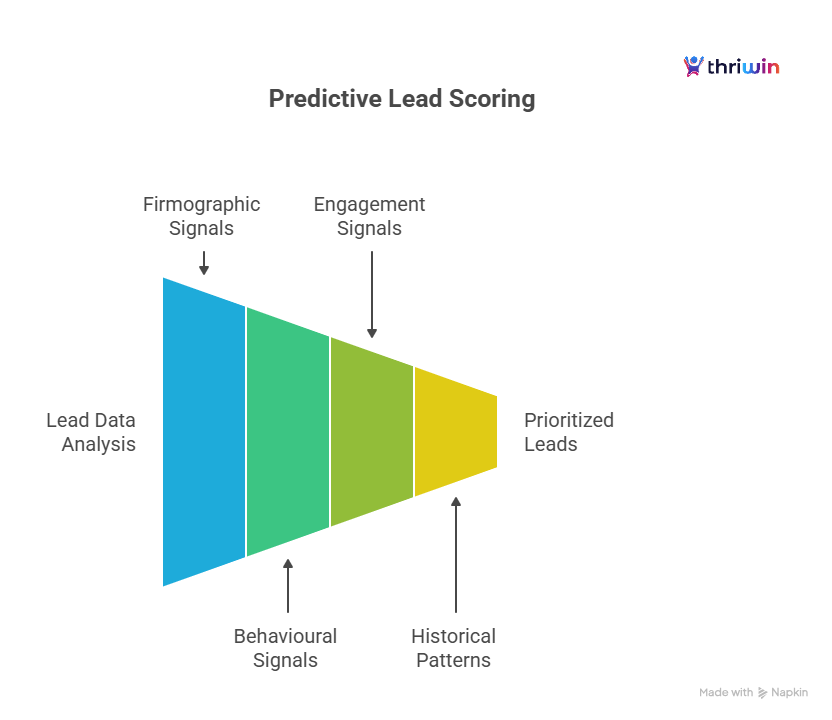
AI analyses behaviour, firmographics, past interactions, website journeys, and email engagement patterns to score leads based on conversion probability. It evaluates a blend of quantitative and qualitative signals to determine how closely each lead matches the profile of past converters.
The model may assess:
- Firmographics: company size, industry, revenue, role, location.
- Behavioral: pages visited, session duration, content downloads, demo requests.
- Engagement: email opens, reply rates, webinar attendance.
- Historical patterns: conversion rates, lifecycle performance, deal attributes.
AI models rank leads and trigger actions—assigning priority, suggesting next steps, or activating personalized outreach.
This approach accelerates pipeline movement and maximizes sales efficiency.
Hyper-Personalized Customer Journeys Powered by AI
AI enables every interaction to adapt dynamically based on behavior, preferences, and real-time signals. Unlike static automation rules, modern AI CRM continuously learns from interactions across email, web, chat, and support, creating a seamless customer journey.
Real-time personalization adjusts messaging, timing, and channels based on engagement cues, ensuring interactions are relevant, timely, and personalized. For instance, abandoned cart triggers or interest-specific content can be automatically pushed, improving conversion chances.
How to Select the Right AI-Powered CRM
Choosing the right AI-powered CRM platform for your business requires more than comparing feature lists-it demands evaluating how deeply AI can integrate into your operations and how reliably it can support long-term growth.
Core selection criteria:
- Automation Depth: Extent of workflow automation across sales, marketing, and support.
- Explainability: Transparency on AI recommendations and scores.
- Integration Ecosystem: Ability to connect with analytics, ERP, marketing, and support systems.
- Data Governance: Reliable cleansing, unified profiles, audit trails, and compliance (GDPR, SOC 2, HIPAA).
Using these criteria helps organisations evaluate AI CRM vendors objectively and identify platforms that offer not only powerful features, but long‑term scalability and reliability.
Why Choose Thriwin as Your AI‑Powered CRM Partner
Selecting the right AI CRM partner can determine how effectively your revenue teams scale, automate, and personalise customer engagement. Thriwin is AI-first, not AI-added, meaning intelligence and automation are core.
- Usage‑Based, Scalable Pricing for All Team Sizes: Unlike traditional CRMs that require heavy upfront costs or long‑term commitments, Thriwin offers flexible, usage‑based pricing. This allows startups and growing teams to tap into enterprise‑level AI capabilities without oversized budgets, paying only for what they need and scaling naturally.
- Unified, Multi‑Channel Sales and Engagement Workflows: Thriwin consolidates email outreach, calling, workflow automation, follow‑ups, and analytics into one cohesive ecosystem. By bringing lead generation, nurturing, and conversion workflows under one roof, teams spend less time switching tools and more time closing deals.
- Rapid Activation & Guided Onboarding: Thriwin focuses on rapid setup, enabling businesses to start generating ROI quickly. With structured onboarding and responsive support, teams avoid the long, complex deployment cycles common with legacy CRM platforms.
AI CRM Is No Longer Optional. It Is Foundational.
AI CRM is now foundational for sustainable growth. Modern businesses need systems that analyze intent, automate execution, and deliver personalized experiences, positioning them for leadership in customer engagement and revenue growth.
FAQs
1. What are some key benefits of AI in improving customer experience in CRM?
Real-time personalization, faster responses, intelligent support routing, predictive recommendations, and consistent engagement.
2. What is predictive lead scoring in CRM?
Machine learning evaluates a lead's conversion likelihood using behavioral signals, demographics, engagement, and historical data.
3. How does predictive lead scoring work?
Signals like website activity, email interactions, firmographics, and past interactions feed ML models to assess conversion probability.
4. How is AI used for lead scoring?
AI identifies behaviors and attributes most correlated with conversion, triggering automated prioritization and next-step recommendations.
5. Can I use AI to generate leads?
Yes. AI automates outreach sequences, identifies high-intent prospects, analyzes behavior, finds lookalike audiences, enriches data, and initiates conversations via chatbots or automated agents.

.webp)
.webp)