%201.svg)


Why SMB Law Firms Should Integrate AI Directly into Their CRM
What happens when a growing law firm is still running on spreadsheets, manual follow‑ups, and scattered client communication? Most small and mid‑sized legal practices face this exact challenge: high client expectations on one side, and lean teams on the other. The result is missed leads, slower intake, compliance risks, and hours of billable time lost every week.
That’s where AI‑enabled CRMs come in. By integrating AI directly into their case‑management and client‑relationship systems, SMB law firms can automate intake, personalize communication, streamline daily workflows, and tighten compliance all without increasing headcount.
In this article, we break down why AI‑CRM integration matters, the problems it solves, the features that really move the needle, and how smaller firms can roll it out step‑by‑step to build a more innovative, more scalable practice.
The Challenges SMB Law Firms Face Today
Small and mid-sized law firms work under intense pressure, limited resources, growing client expectations, and the constant need to stay compliant. Traditional CRMs may centralize information, but they don't actively reduce this operational load. Here’s what these firms are up against.
Resource Constraints and Manual Operations
Most SMB firms don't have a full-fledged marketing or business development team. That means critical tasks like client intake, follow-ups, and lead tracking fall on already-stretched attorneys or administrative staff.
Instead of focusing on billable hours, teams often lose time to manual data entry, toolemail tracking, or lead management across spreadsheets. Even when a CRM is in place, it’s usually just a database. Without automation, it becomes a static tool, organized, but not intelligent.
The result? Delayed responses, missed leads, and valuable time wasted on non-billable work.
High Client Expectation and Communication Demands
Today’s legal clients expect immediate attention. They want seamless communication, fast turnarounds, and clarity at every step. Without AI-enhanced workflows, firms struggle to meet those demands consistently. Responses become reactive instead of proactive. Conversations get lost in inboxes. Leads go cold before anyone gets a chance to reply.
Legal-specific CRM tools do exist, and many support email and calendar sync, document management, and client pipeline tracking. But without intelligent automation stitched into those tools, firms still risk missing the mark.
Need for Better Insights and Growth Visibility
In most SMB law firms, growth decisions are made on gut feeling, not real data. While CRMs do a decent job of storing client and case information, they don’t offer much in the way of predictive insight.
Which clients are most likely to convert? Which cases are draining your time with little return? Which practice areas are most profitable? A traditional CRM won’t tell you that.
AI-enabled CRMs, however, can surface those insights. They help firms identify patterns, track conversion triggers, and align internal resources where they matter most.
Compliance, Risk, and Client Confidentiality
Law firms aren’t just managing client relationships; they’re managing risk. Sensitive client data must be stored securely, workflows must align with legal ethics, and every action needs to be traceable. Adding AI into the mix raises essential questions: Is this system secure? Is it trained on private data? Will it hold up to audit scrutiny?
The right CRM designed for legal workflows will address those concerns head-on. It won’t just record data; it will enforce access controls, log every change, and monitor for risks in real time. As frameworks like “LegalGuardian” have shown, responsible AI use in legal tech is not optional; it’s essential.
How AI‑Enabled CRM Solves These Problems
Once the right AI capabilities are built into a CRM, SMB law firms stop firefighting and start operating with clarity, consistency, and control. This section breaks down exactly how that happens across core workflows and outcomes.
Automated Lead Capture & Qualification
An AI‑powered CRM doesn’t wait for staff to manually enter lead details. It captures website form submissions, chat interactions, and even email inquiries, automatically scoring each prospect based on intent signals and urgency. Even when your team is away or juggling case work, the system stays on. Leads are triaged, categorized, and queued up for action.
According to legal tech commentary on platforms like JD Supra, this kind of automation helps SMB law firms avoid missed opportunities and reduce intake lag. The result? More qualified leads move through the pipeline, while low‑quality ones are filtered out without wasting team effort.
Personalized Client Outreach at Scale
No more “just checking in” emails. With AI modules running behind the scenes, the CRM can tailor messages based on previous interactions, client type, and case stage.
Whether it’s a follow‑up with a prospect who opened your pricing sheet or a reminder to a paralegal to request key documentation, the system keeps everyone on track without manual nudges. Reviews of law-specific CRMs highlight how this kind of personalized automation, once exclusive to enterprise firms, is now increasingly accessible to smaller practices. It’s not about blasting messages. It’s about sending the right one, at the right time, to the right person.
Predictive Insights for Growth & Retention
AI integration unlocks another layer: foresight. Instead of reactive reporting, the CRM starts identifying which leads are most likely to convert, which clients are most likely to disengage, and which practice areas are generating the most long‑term value.
Thriwin, for example, emphasizes how predictive analytics transforms raw case and client data into clear, actionable insights. That shift allows firms to allocate resources wisely, tailor their service mix, and stay ahead of churn risks.
When a firm knows which cases yield the best outcomes or which patterns signal that a client may be slipping, it can act early and strategically.
Workflow Efficiency & Team Enablement
AI‑CRM setups are built to handle the routine stuff, so your team doesn’t have to.
From logging interactions and scheduling follow-ups to triggering document reminders and automating conflict checks, these systems quietly remove friction from daily operations.
For time-strapped attorneys and lean admin teams, that’s a game-changer. They get to focus on higher-value legal work while the CRM quietly ensures nothing slips through the cracks.
Insights from sources like Dialzara reinforce that for SMBs, AI-powered CRM is less about fancy tech and more about reliable, scalable execution. Fewer errors, faster task handoffs, and a more consistent client experience all come standard.
Compliance & Secure Client Data Management
In the legal field, compliance isn’t a checkbox; it’s a professional obligation. That’s why AI integration must be designed with built-in guardrails.
A well-structured CRM will enforce role-based access, retain detailed audit trails, and apply firm-defined policies to every record and communication. But when enhanced with AI, the system can go further, flagging unusual activity, surfacing risk indicators, and enforcing protocol without constant supervision.
For small and mid-sized law firms, this means peace of mind. It’s not just about storing client data; it’s about ensuring it stays protected, accurate, and ethically managed at every step.
And when the firm is audited or challenged, the CRM doesn’t just hold the data. It tells the story clearly and thoroughly.
Core Features to Look for in an AI‑Enabled Legal CRM
Not every CRM is ready for the demands of a modern law firm, especially when it comes to AI. For SMB firms, the right system does more than store data; it actively drives growth, protects compliance, and lightens the team’s operational load. Here’s what to prioritize.
Lead & Intake Automation
A legal CRM with AI should do more than capture contacts. It should include website forms and chatbots that feed leads directly into the system, automatically score them based on relevance or urgency, and route them to the right attorney or intake team. With intelligent intake workflows, high‑value leads move forward faster without manual triage or delay.
Multi‑Channel Communication Logging
Client conversations rarely happen in one place. A capable CRM consolidates emails, phone calls, chat transcripts, and uploaded documents into a single, organized view. With AI summarising what was said and even detecting tone or sentiment, your team gets context at a glance. Follow-ups, reminders, and next steps can be triggered automatically, reducing response times and human error.
Predictive Analytics & Reporting
Traditional reporting tells you what happened. AI‑powered CRMs help you see what’s likely to happen next. From predicting which leads are most likely to convert, to forecasting billing potential or spotting clients at risk of churn, the right CRM provides a clear view of growth opportunities and risks. It replaces guesswork with data-backed decision-making.
Document & Workflow Automation
Legal work involves repetitive documentation, engagement letters, NDAs, and case summaries. AI-enabled CRMs support template generation, suggest follow-up actions based on context, and automatically track deadlines. Conflict checks, e-signatures, and task assignments can all be built into the workflow, ensuring nothing slips through the cracks from intake to invoice.
Data Security, Compliance & Ethics
Legal data isn’t just sensitive, it’s sacred. AI-enabled CRMs must include robust encryption, audit logs, and role-based access control. Equally important is ethical AI: models should be trained responsibly, avoid bias, and align with your firm’s data policies. Frameworks like LegalGuardian (arXiv) stress the importance of building compliance into every layer of the system, not bolting it on after.
Integration Ecosystem & Scalability
Your CRM should plug into the tools your firm already uses, including billing software, document management systems, time-tracking tools, and marketing platforms. Just as important is modular scalability: the ability to turn on advanced features like AI scoring or predictive insights as your needs evolve.
Implementation Playbook for SMB Law Firms
Integrating AI into your CRM isn’t a flip-the-switch upgrade. It’s a strategic process that requires clarity, structure, and the right change management approach. Below is a five-step rollout plan tailored for small and mid-sized law firms aiming to get it right the first time.
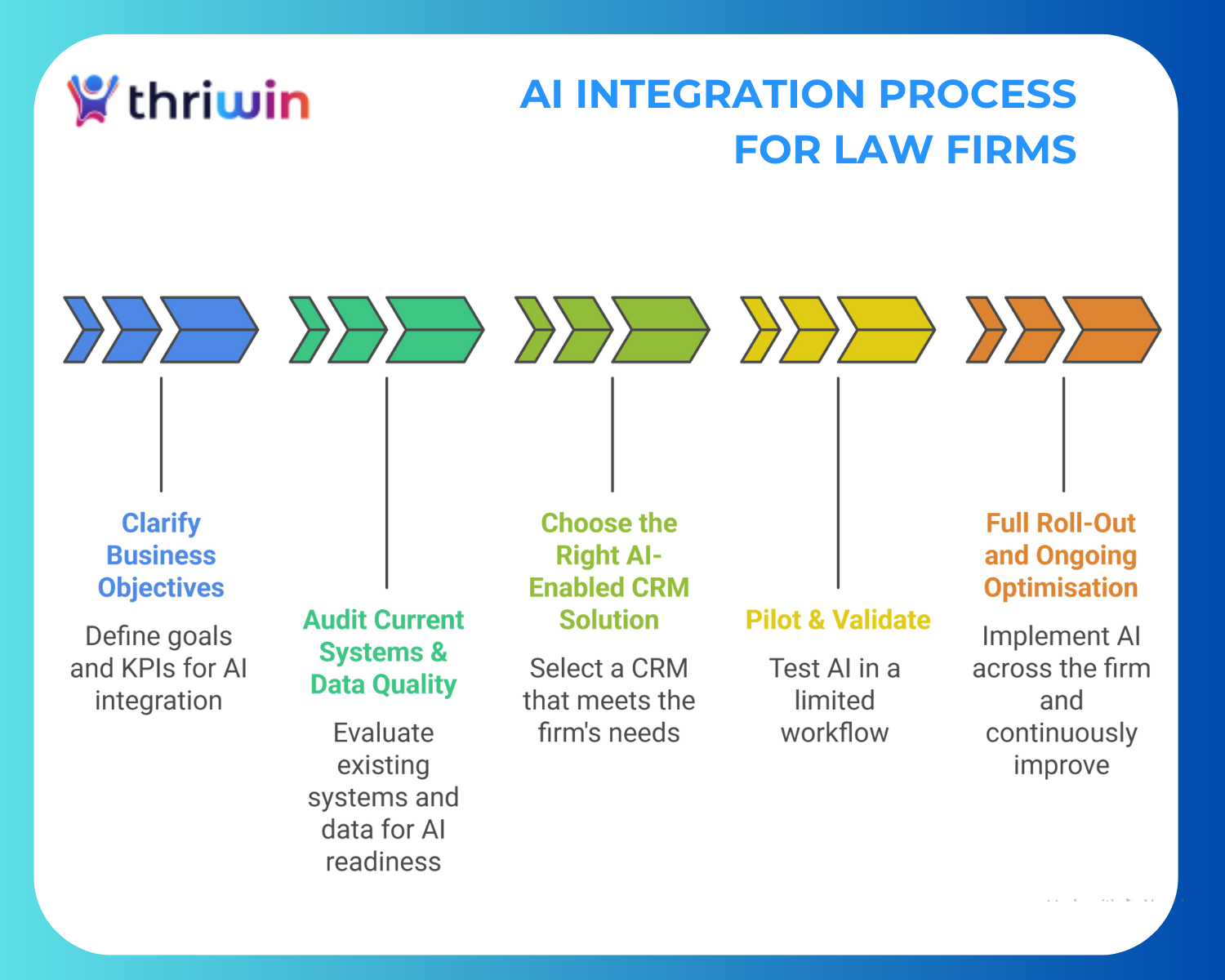
Step 1 – Clarify Business Objectives
Start by defining what success looks like. Do you want to increase lead conversion? Speed up client intake? Improve retention or reduce follow-up time? Pinpoint 1–2 primary goals that align with your firm’s growth strategy.
Next, set measurable KPIs such as reducing unconverted leads by 30% or cutting intake response time by 50%. These metrics will help you track real impact. Lastly, get buy-in from all relevant stakeholders: partners, admin staff, intake coordinators, and IT support. Everyone needs to understand what’s changing and why.
Step 2 – Audit Current Systems & Data Quality
Before layering AI onto your CRM, audit what you already have. Map how leads currently come in, how they’re handled, and where communication happens, forms, spreadsheets, email threads, or siloed software.
Evaluate data quality. Are fields consistently filled? Are there duplicates or outdated entries? Clean, structured data is the foundation for AI functionality. As highlighted in Thriwin’s insights, AI models are only as effective as the data they’re trained on. Spend time here; it pays off later.
Step 3 – Choose the Right AI‑Enabled CRM Solution
With your goals defined and systems mapped, it’s time to evaluate CRM options. Use the earlier feature checklist as a guide, look for platforms that offer intake automation, predictive analytics, secure workflows, and strong integration capabilities.
Pay special attention to vendor transparency on data ethics, AI governance, and compliance standards. You’re not just buying software, you’re choosing a system that will hold sensitive legal data. Consider pricing models, onboarding support, and ease of use, especially if your team isn’t tech-heavy.
Step 4 – Pilot & Validate
Start small. Select a narrow workflow, such as new client intake for a single practice, and configure AI scoring, routing, and automation just for that pilot. Run it live with genuine leads for 2–4 weeks.
Measure what matters: response times, lead conversion, staff usage rates, and any data inconsistencies. Use this pilot to catch friction points early and refine your setup before expanding firm-wide.
Step 5 – Full Roll‑Out and Ongoing Optimisation
Once your pilot proves value, roll out the system across other departments or practice areas. Create internal training sessions to ensure lawyers and staff are confident using the tools daily. Appoint internal champions who can help with adoption and troubleshooting.
Establish a monthly or quarterly review cadence to assess KPIs, refine AI scoring models, and optimize workflows. Ensure compliance features are actively monitored: audit logs are reviewed, AI outputs are checked for bias, and governance rules are consistently enforced.
The goal isn’t just automation, it’s creating a more innovative, more accountable firm that scales with precision and confidence.
Future Outlook for Law Firm AI‑CRM Integration
AI-powered CRMs are rapidly evolving, and SMB law firms that act early will gain significant ground. Here’s what’s next.
Greater Personalisation
AI will tailor interactions by case type, communication style, and behaviour, enabling firms to offer more responsive, high-touch service that drives client satisfaction and referrals.
Embedded Legal Intelligence
CRMs will go beyond automation, offering case success predictions, profitability insights, and workload forecasting. Tools informed by AI research will help firms make faster, smarter decisions.
Compliance-First Design
As regulatory focus on AI ethics increases, CRMs must embed governance from the start. Bias checks, audit trails, and role-based controls will become default, not optional.
Scalable Access for SMBs
As pricing becomes more flexible and tools more modular, smaller firms will gain access to powerful AI capabilities without heavy upfront investment, leveling the playing field.
Bringing AI and CRM Together for Smarter Legal Growth
For today’s SMB law firms, efficiency isn’t just a competitive edge, it’s a necessity. Manual processes slow teams down, scatter client data, and introduce costly gaps in communication and compliance. AI-enabled CRMs offer a way out, helping firms automate the repetitive, anticipate client needs, and make smarter, faster decisions.
This isn’t just about technology. It’s about building a legal practice that’s more responsive, more consistent, and better equipped to grow without growing overhead.
With the right CRM, powered by AI and built for legal workflows, smaller firms can finally operate with the precision and speed once reserved for large practices.
Ready to move from manual to intelligent?
Book a demo with Thriwin and see how AI can simplify your CRM and accelerate firm-wide growth.
FAQs
What does it mean to integrate AI into a CRM for a law firm?
It means embedding artificial‑intelligence capabilities such as lead scoring, automated follow‑ups, predictive analytics, and communication summarisation directly into your CRM system so that data flows, decisions, and actions become smarter, faster, and more efficient.
Are AI‑enabled CRMs suitable for small law firms with limited budgets?
Yes, any SMB‑focused AI‑CRM solutions are designed to be cost‑effective, starting with specific features (like intake automation) and scalable over time. The key is to select a vendor whose pricing and deployment model match your firm’s size and growth strategy.
How can I ensure client confidentiality when using AI with legal data?
Choose AI‑CRM tools that embed strong data governance, role‑based access, audit logs, and bias monitoring. Also, ensure that the AI models are transparent and the system aligns with your firm’s professional‑responsibility obligations. Legal research emphasizes this requirement.
What kind of ROI can I expect from integrating AI into my law firm's CRM?
While results vary by firm and practice area, benefits often include faster lead conversion, fewer missed opportunities, improved client retention, and more efficient use of attorney time. The predictive analytics component can also help optimize resource allocation and case profitability.
How should a law firm begin the journey of AI‑CRM integration?
Start with a clear objective (e.g., increase conversion, reduce follow‑up time), audit your current systems and data, choose a pilot area, implement a targeted workflow, measure results, then expand. Ensuring training and change‑management support is also crucial.

.webp)
.webp)