%201.svg)


The way small and mid-sized businesses manage sales is entering a major shift. CRM systems-once used mainly for contact storage and pipeline tracking-are no longer enough for sales teams dealing with faster buying cycles, rising customer expectations, and shrinking attention spans. Today, CRMs must do more than organize information. They must sell.
Integrated AI sales agents are emerging as the next default layer inside CRM platforms. Instead of teams manually chasing leads, logging activities, sending follow-ups, or updating fields, AI agents now handle these repetitive tasks while guiding sales reps toward higher-intent opportunities. For SMBs with lean teams, limited resources, and ambitious revenue goals, this evolution is not optional. It’s competitive survival.
This article explores why AI-powered sales agents are becoming the new standard for SMB CRMs, what capabilities matter, the ROI they deliver, and how SMBs can transition smoothly into this new era with platforms like Thriwin leading the way.
Why SMBs Can No Longer Treat AI Sales Agents as Optional
Small and mid-sized businesses are entering a sales environment that rewards speed, consistency, and intelligent engagement. Buyers expect real-time responses, tailored interactions, and frictionless experiences across every channel. Traditional CRMs-built only to store data-can’t keep up with these demands anymore.
AI-powered sales agents have now become essential, helping SMBs automate critical tasks, eliminate pipeline gaps, and operate with the efficiency of teams twice their size.
The Changing Sales Landscape for SMBs
SMBs are under unparalleled pressure today. Buyers expect instant outreach, personalized responses, and consistent follow-ups across channels. The average prospect receives more messages, interacts with more brands, and takes longer to make a decision than a decade ago. Yet SMBs often operate with small sales teams, limited headcount, and minimal automation.
This imbalance causes several problems:
- Slower response times
- Missed follow-ups
- Manual lead qualification
- Reps are spending most of their day updating the CRM
- Pipeline leakage
Customers now expect speed and intelligence by default. An SMB that takes 48 hours to follow up simply loses deals to competitors who reply in minutes-usually powered by AI.
Limitations of Traditional CRMs Without Embedded Intelligence
Conventional CRMs were built to store data, not act on it. They provide structure but rely completely on the sales team for execution.
This means:
- No automatic lead scoring
- No proactive outreach
- No automated qualification
- No dynamic follow-up sequences
- No insight-driven task creation
- No recommendations for next actions
Worst of all, CRMs without integrated AI depend heavily on manual data entry. And when sales reps are busy selling, data gets messy. Without complete and accurate data, reporting becomes unreliable, forecasts become optimistic guesses, and managers lose visibility.
SMBs need tools that do the work-not tools that create more work.
The Rise of AI-Driven Sales Agents: What’s Different
AI sales agents operate like autonomous digital teammates. They sit inside the CRM, analyze sales data in real time, and perform tasks proactively, not reactively.
These agents can:
- Score every lead based on behavior and intent
- Trigger instant follow-ups
- Send multi-channel outreach
- Update CRM fields
- Capture call notes
- Summarize conversations
- Assign tasks
- Recommend next actions
- Drive workflows from end to end
Unlike traditional automation, AI agents continuously learn from patterns, outcomes, and team behavior-making them smarter over time. For SMBs struggling with bandwidth, these agents multiply productivity instantly without adding headcount.
What “Integrated AI Sales Agents” Actually Mean in an SMB CRM
AI inside a CRM is no longer limited to basic suggestions or automated reminders. Integrated AI sales agents represent a deeper shift-where intelligence becomes part of the CRM’s core, not an add-on sitting on top of it. For SMBs, this means your CRM doesn’t just store information; it actively works alongside your team, handles repetitive tasks, predicts next actions, and ensures every lead moves forward without manual effort. This is the difference between a static database and a dynamic sales engine.
Defining AI Sales Agents
AI sales agents are autonomous digital operators designed to execute sales activities end-to-end with minimal input from your team. They interpret buyer intent, scan CRM data, and automatically trigger actions, ensuring no lead is forgotten or left idle. Instead of waiting for a rep to remember follow-ups, these agents manage outreach, maintain active conversations, schedule demos, prepare instant summaries, and keep every CRM record up to date in real time. What once required hiring additional reps is now built directly inside the CRM, operating 24/7 without fatigue or inconsistency.
Integration vs. Add-On: Why Full Embedding Matters
Many CRMs today promote AI “features,” but most are nothing more than external plugins layered on top of an outdated system. Integrated AI, however, is fundamentally different because it is embedded at the workflow level-meaning the CRM and the AI agent operate as a single unit. This removes the need to switch between tabs, export data into other systems, or reconcile different sources of truth. By working directly from the CRM’s core, integrated AI eliminates sync issues, reduces tool fatigue, and ensures every action- from outreach to qualification-happens in one place. For SMBs that value simplicity and speed, this level of integration prevents operational overhead and ensures reps stay focused on selling, not on wrestling with tools.
Essential Capabilities of an AI-Driven CRM
A modern AI-powered CRM must do more than automate reminders, it should actively take over the repetitive, high-volume tasks that slow sales teams down. These are the core capabilities SMBs should expect from a truly integrated AI system:
• Intelligent Lead Scoring
AI identifies high-intent leads by analyzing engagement, fit, and behavior, helping reps focus on prospects most likely to convert.
• Automated Multi-Channel Outreach
Personalized messages across email, WhatsApp, SMS, and LinkedIn are sent at the right moment based on buyer actions-not fixed schedules.
• Smart Follow-Ups
Follow-up sequences adjust automatically depending on prospect behavior, ensuring timely responses without manual tracking.
• Instant AI Notes & Summaries
Meetings and calls are converted into clean summaries, saving reps from hours of manual documentation.
• Real-Time CRM Updates
AI enriches and updates CRM fields automatically, keeping data clean and reliable without human effort.
• Intent Detection
Signals like repeated email opens or page visits trigger automated actions to engage prospects at their peak interest.
The Benefits for SMBs: Why the ROI Is Already Real
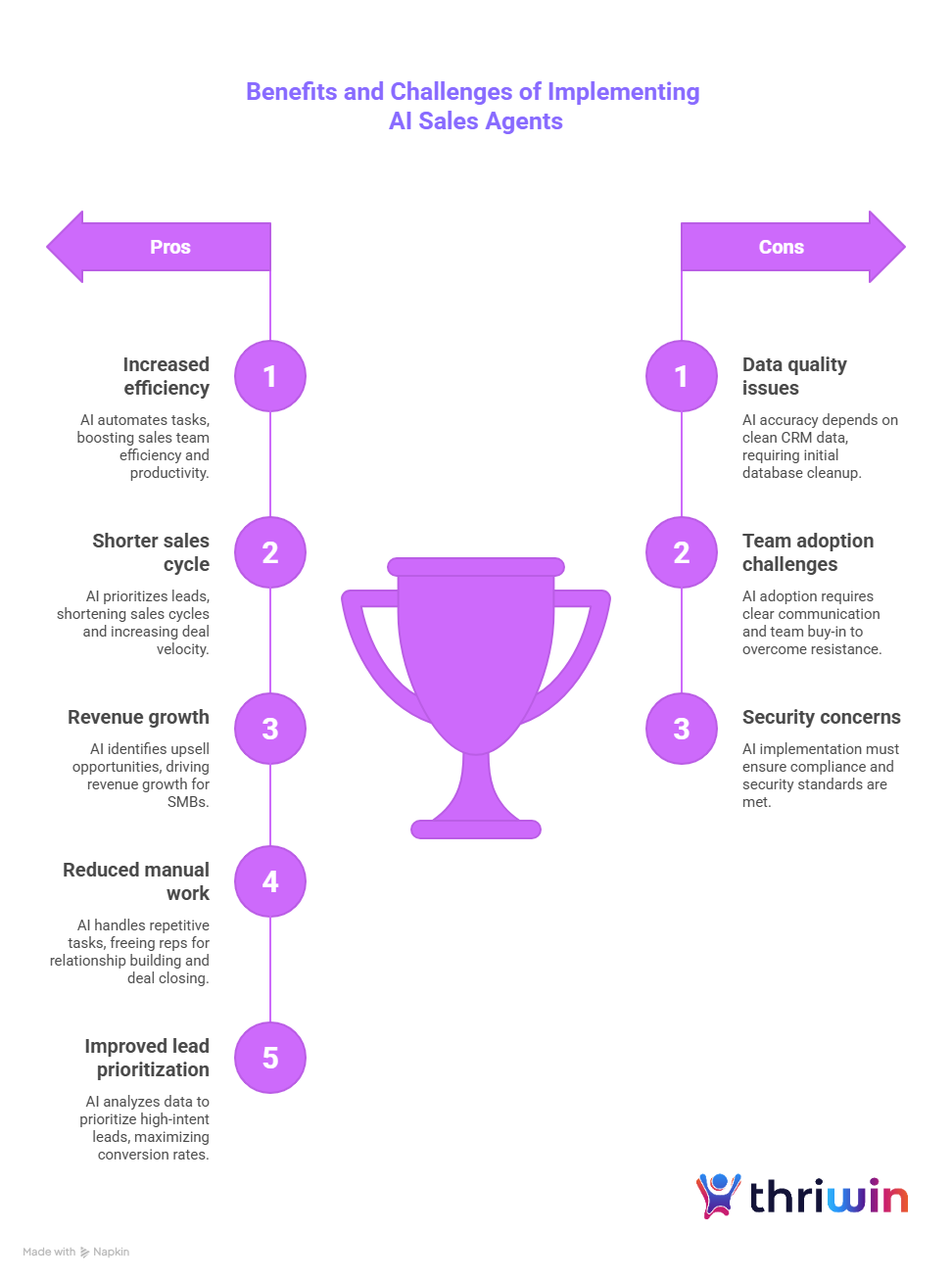
AI sales agents are not just a nice-to-have upgrade-they deliver measurable impact from day one. For SMBs operating with leaner teams and tighter budgets, AI improves sales efficiency, accelerates deal velocity, and reveals revenue opportunities that would otherwise remain hidden. When the CRM begins acting as a proactive sales engine rather than a passive database, the return on investment becomes obvious and immediate.
Smarter Lead Prioritization That Shortens the Entire Sales Cycle
AI agents remove the guesswork from sales by highlighting the leads most likely to convert. Instead of treating every prospect equally, the system analyzes engagement patterns, past interactions, industry relevance, and buying signals to surface high-intent opportunities. This shift allows SMB teams to focus their efforts where they count-often on the top 20% of leads that generate the majority of revenue. The result is a shorter, more predictable sales cycle because reps spend less time chasing cold prospects and more time closing warm ones.
Higher Revenue Through Timely Upsell and Cross-Sell Opportunities
AI doesn’t just help with new leads-it continuously monitors existing customers to identify growth opportunities. It detects behaviors such as approaching usage limits, stalled activity, repeated interest in a new product, or multiple email opens. These early signals often go unnoticed by a busy sales team, but AI flags them instantly and recommends the right next step. SMBs can turn these insights into real revenue by acting early instead of reacting too late.
Significantly Reduced Manual Work and a Boost in Sales Productivity
Reps typically spend much of their day logging calls, updating CRM fields, drafting follow-ups, scheduling meetings, or preparing notes. AI sales agents take over these repetitive tasks, freeing reps to do what they do best-build relationships and close deals. This shift lets SMBs operate with the efficiency of a much larger team, often delaying the need to hire more reps while still increasing output and pipeline coverage.
Common Challenges and How to Overcome Them
Adopting AI sales agents delivers massive gains, but SMBs often run into a few predictable hurdles during implementation. These challenges are not roadblocks-they’re simply areas that need attention before AI can perform at its full potential. The good news is that each challenge has a straightforward solution. With a few foundational adjustments, SMBs can unlock the true value of integrated AI inside their CRM.
Create a Clean, Consistent CRM Foundation So AI Can Learn Accurately
AI is only as reliable as the data feeding it. If the CRM is filled with duplicates, incomplete fields, or outdated contacts, the system can’t analyze patterns correctly or make accurate recommendations. Before launching AI agents, SMBs should take time to tidy up their database by merging duplicate records, updating missing details, archiving stale leads, and ensuring custom fields reflect the actual sales process.
A clean CRM gives AI a strong foundation to work from, improving accuracy from day one and preventing the system from learning the wrong behaviors.
Ensure Smooth Team Adoption by Positioning AI as Support, Not Replacement
One of the most common challenges during AI rollout isn’t technical-it’s human. Sales teams often worry that AI will replace their role or micromanage their work. In reality, AI agents remove the repetitive tasks that reps dislike anyway and give them more time to focus on conversations, relationships, and closing deals.
SMBs can ease adoption by clearly communicating the purpose of AI, offering hands-on demos, and showing early wins. When reps see that AI sends their follow-ups, updates
their CRM entries, and prepares their call summaries automatically, skepticism quickly turns into relief. Adoption rises naturally once the team realizes AI is a powerful assistant-not a threat.
Address Security, Compliance, and Scaling Needs Before Expanding AI Usage
As AI becomes more involved in sales operations, SMBs must ensure the platform they use meets modern compliance and security standards. This includes GDPR and CCPA alignment, safe data storage practices, encrypted communication, and role-based access controls.
Scaling is another challenge-AI must work just as smoothly when your leads triple or your team expands. This is why SMBs should choose platforms built with strong infrastructure and automated data management. With the right foundation, AI scales effortlessly while keeping compliance and security intact, giving SMBs confidence to expand usage across the entire sales process.
Step-by-Step Guide for SMBs to Adopt Integrated AI Sales Agents
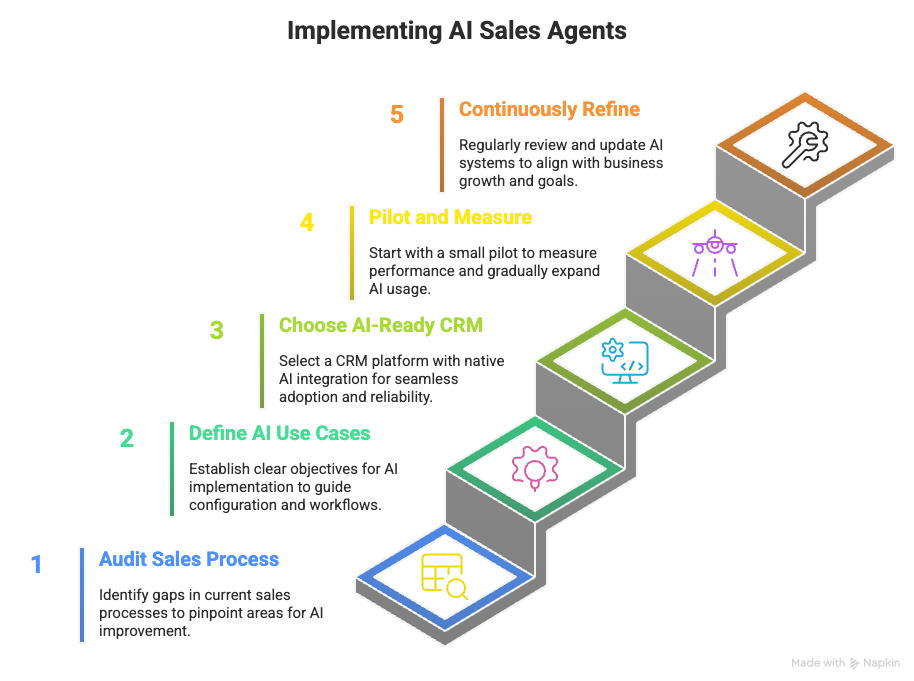
Adopting AI doesn’t have to be overwhelming. When SMBs follow a structured, intentional approach, AI sales agents become easier to implement and far more effective long-term. This framework helps teams transition smoothly from manual selling to an automated, intelligence-driven sales engine.
Step 1: Audit Your Current Sales Process to Identify Gaps AI Can Solve
Before introducing AI, SMBs should understand how leads flow through their system today. This means reviewing how leads enter the CRM, how quickly reps respond, where follow-ups are missed, and which tasks take the most time. By mapping these gaps, businesses can pinpoint where AI can deliver immediate improvement, such as automating follow-ups, qualifying leads, or enriching CRM data.
Step 2: Define Clear AI Use Cases and Sales Objectives
AI works best when the goal is sharply defined. SMBs should outline what they want the AI agent to focus on first-whether it’s faster lead responses, automated outreach, better qualification, or improved CRM hygiene. These objectives act as the blueprint for configuring workflows, follow-up sequences, scoring rules, and communication templates.
Step 3: Choose a CRM Platform Built for Native AI Integration
Not all CRMs are capable of truly integrated AI. SMBs should look for platforms where AI is embedded into the core system, not bolted on as a plugin. The right tool should offer multi-channel outreach, real-time data updates, simple onboarding, pay-as-you-scale pricing, and strong support. A native AI CRM-like Thriwin-ensures smoother adoption, better reliability, and fewer technical issues.
Step 4: Start With a Small Pilot, Measure Performance, and Expand Gradually
Launching AI across the entire sales process at once can feel overwhelming. Instead, SMBs should begin with a controlled pilot-perhaps a single team, lead segment, or workflow. This allows them to measure impact with clarity. Key metrics include response times, conversation rates, follow-up consistency, and AI-driven conversions. Once the results show improvement, SMBs can confidently scale AI usage across more teams and processes.
Step 5: Continuously Refine the System as the AI Learns and Your Team Grows
AI sales agents improve over time by learning from team behavior, successful deals, and buyer responses. SMBs should periodically review AI decisions, update messaging, refine scoring rules, and expand workflows. As the business grows, AI can be tuned to support new products, larger teams, and more complex sales motions. Continuous refinement ensures AI remains aligned with your goals and keeps delivering long-term ROI.
Why Thriwin Is the CRM Built for the Next Era of SMB Sales
Thriwin isn’t a CRM with AI added on top-it’s a CRM built around AI from the start. By combining automation, AI sales agents, and multi-channel communication in a single platform, Thriwin removes manual work, eliminates tool chaos, and keeps every lead moving without gaps.
Your team gets instant outreach, smarter prioritization, automated follow-ups, clean CRM updates, and real-time insight into buyer intent. Instead of spending time on admin tasks, reps focus on closing deals.
AI-driven selling is now a competitive necessity. With Thriwin, you get a CRM that actively drives your pipeline-not one that simply records it.
Boost your sales efficiency today. Activate Thriwin’s Integrated AI Sales Agents and scale faster with the same team.
FAQs
1. What is an AI sales agent in a CRM?
An AI sales agent is a built-in system that automates sales tasks such as lead scoring, follow-ups, outreach, meeting scheduling, and CRM updates. It works like a digital teammate that keeps your pipeline warm, responds instantly, and handles repetitive work so your reps can focus on closing deals.
2. Do small and mid-sized businesses really need AI in their CRM?
Yes. SMBs deal with limited headcount, slower follow-up times, and inconsistent manual processes. AI helps automate tasks that teams don’t have time for, ensuring leads are contacted faster, qualified more accurately, and moved through the funnel without gaps.
3. How does an AI-powered CRM improve sales performance?
AI boosts performance by identifying high-intent leads, triggering timely outreach, reducing manual work, summarizing conversations, detecting buying signals, and guiding reps with recommended next steps. This leads to faster sales cycles and higher conversion rates.
4. Is AI difficult or expensive for SMBs to implement?
Modern AI CRMs are designed to be simple, affordable, and ready to use without technical teams. SMBs can get started quickly because most AI features run automatically in the background and don’t require complex setup or custom development.
5. Can AI sales agents replace traditional automation tools?
Yes. AI agents are far more dynamic than rule-based automation. They adapt to buyer behavior, interact across channels, prioritize leads based on intent, and update the CRM intelligently. Instead of fixed workflows, AI gives SMBs a system that continuously learns and improves.

.webp)
.webp)